

Most organizations claim innovation as a strategic priority, but few recognize that their design choices are systematically eliminating it. When products, services and workplaces are for only one way of living, working or thinking, we create exclusion by default, therefore excluding 1.3 billion people.
But the problem extends beyond exclusion. Inaccessible design signals something more damaging – organizations aren’t thinking about diverse users, diverse use cases or diverse ways of solving problems. And that narrow thinking costs.
Retrofitting versus universal design
There is a common pattern that plays out across industries: organizations develop products, build platforms and design services. Then – often after launch, sometimes after complaints, occasionally after litigation – they retrofit accessibility.
The problem is that retrofitting accessibility creates clunky workarounds instead of seamless experiences. Users can tell when accessibility was an afterthought rather than a design principle. Features feel bolted on rather than integrated. User experience suffers. And the innovation that emerges when accessibility shapes design from the beginning never materializes.
Take digital interfaces: when accessibility is retrofitted, screen reader compatibility gets added to existing visual designs. When accessibility shapes design from the start, interfaces become clearer, navigation improves and usability increases for everyone – not just disabled users.

Designing for disabled users generates insights that transform offerings for everyone.
We know that designing for disabled users generates insights that transform offerings for everyone. The examples are familiar by now: curb cuts, initially created for wheelchair users, benefit people pushing prams, pulling luggage and making deliveries. Closed captions, essential for deaf users, are used by 80 percent of viewers in sound-sensitive environments or non-native language contexts. Voice controls, critical for people with mobility impairments, became mainstream features that millions now prefer.
Designing for disability forces organizations to question assumptions. Standard keyboards don’t work for everyone – what alternatives exist? Visual interfaces exclude blind users – how else can information be conveyed? Fixed schedules disadvantage people with fluctuating conditions – what flexibility is possible?
When designers must accommodate diverse abilities, they create more flexible systems. When engineers build for multiple input methods, they develop more robust platforms. When organizations design workplaces for varied needs, they build environments that adapt better to everyone.
The pattern repeats: accessibility features designed for specific disabilities become preferred options for broader populations. But this multiplier effect only emerges when accessibility shapes design from the beginning, not when it’s added as an afterthought.
Designing inclusive workplaces
The same principles apply to workplace design. Organizations building physical and digital work environments around a narrow set of abilities create barriers that reduce productivity, limit participation and exclude talent.
Open-plan offices disadvantage people sensitive to noise and visual distraction. Rigid schedules exclude people managing fluctuating health conditions. Communication practices that rely heavily on unspoken social cues marginalize neurodivergent employees. Technology platforms that aren’t screen-reader compatible prevent blind employees from accessing information their colleagues take for granted.
None of these design choices are inevitable. They’re defaults – often unconscious ones – that can and must be redesigned.
Forward-thinking organizations are approaching workplace design with the same Universal Design principles they apply to products. They create spaces with options: quiet zones and collaborative areas, flexibility around when and where work happens, multiple communication formats and technology that works for diverse users from implementation.

When businesses design for a wider range of human interaction, they create smarter, more adaptable institutions.
The result isn’t just increased accessibility. It’s increased flexibility that benefits everyone – parents managing school schedules, people handling long commutes, anyone needing focused work time, employees with varying productivity patterns.
HSBC UK’s rollout of British Sign Language (BSL) training for all 23,000 employees illustrates what happens when organizations redesign communication proactively rather than reactively. Sparked by one manager recognizing a communication gap after welcoming a deaf colleague, the initiative evolved into a systemic shift: moving from individual accommodation to organization-wide capability building.
Instead of treating accessibility as a specialist adjustment, HSBC embedded deaf awareness and basic BSL communication into workforce development at scale. This shift improves experiences for deaf employees and customers while simultaneously strengthening broader communication awareness across the organization.
By investing in inclusive communication before barriers escalate, HSBC demonstrates how accessibility can reshape systems to be more responsive, more human and ultimately more effective for everyone. The result is not simply better compliance, but stronger organizational resilience, proving that when businesses design for a wider range of human interaction, they create smarter, more adaptable institutions.
‘Nothing about us, without us’
Universal Design succeeds when disabled people participate in the design process from the beginning. The phrase ‘nothing about us, without us’ captures this essential principle: you cannot design effectively for users whose experiences you don’t understand.
Organizations that excel at accessible design don’t just consult disabled users for feedback on prototypes. They include disabled people on design teams, involve them in strategy discussions and compensate them appropriately for expertise. This participation transforms outcomes because lived experience reveals use cases and barriers that non-disabled designers simply don’t anticipate.
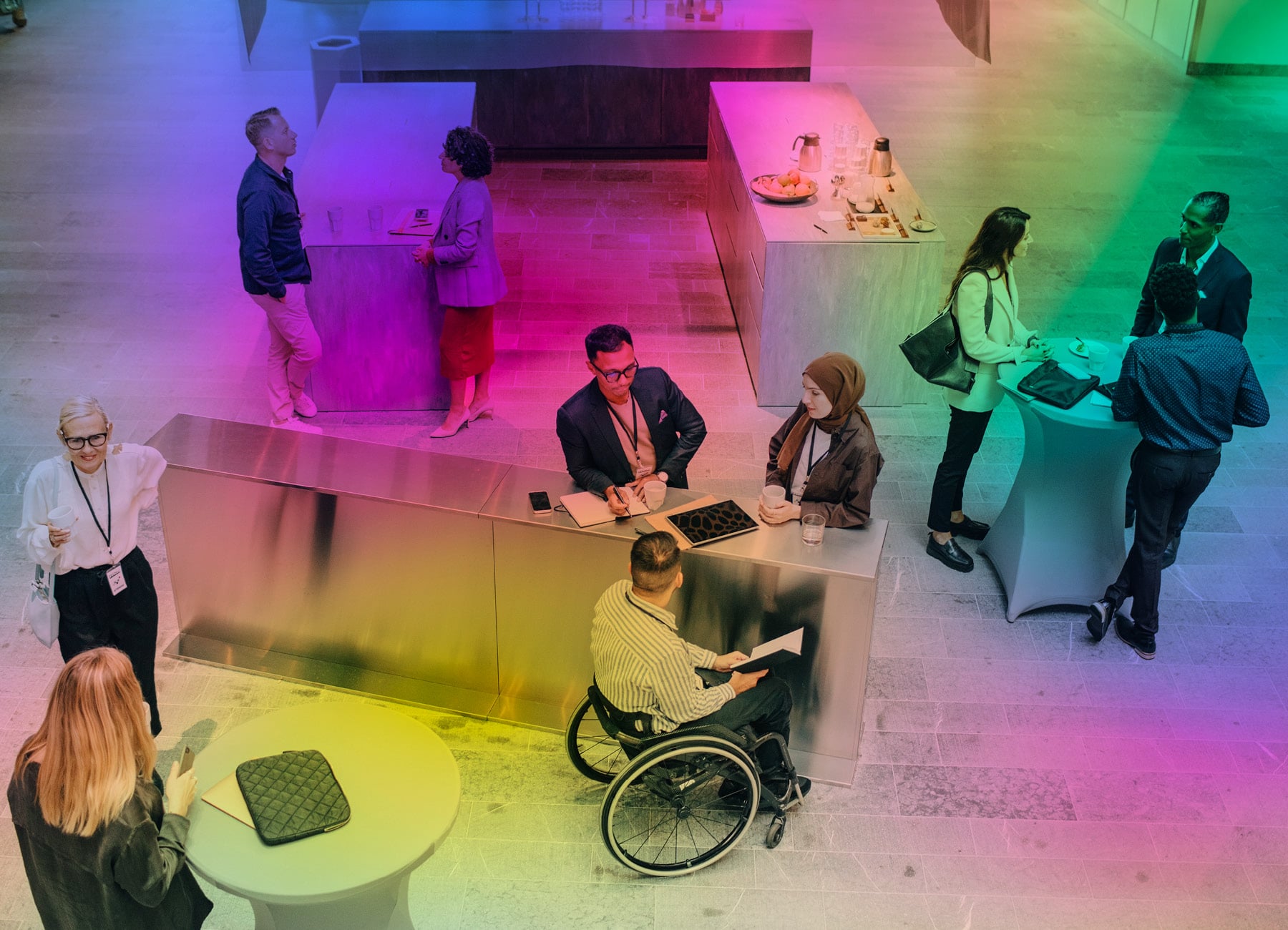
Inclusive design becomes a way of building workplace systems in which people are seen, heard and able to thrive.
LSEG’s internal storytelling platform shows that inclusion is shaped not only by policy, but also by visibility and participation. By producing a film grounded in employees’ lived experiences and creating space for colleagues to share their stories, LSEG moved beyond performative awareness towards intentional culture-building. Rather than relying solely on top-down frameworks, it created a structure that enables employees to shape how inclusion is understood in the workplace.
This reflects a core Universal Design principle: organizations make better decisions when the people most affected help shape the environment from the start. By centring authentic employee voices, LSEG strengthened belonging, deepened empathy and fostered a culture better able to recognize and respond to diverse needs. In this context, inclusive design becomes a way of building workplace systems in which people are seen, heard and able to thrive.
Moving beyond compliance
Most organizations still approach accessibility through a compliance lens: meet legal requirements, avoid litigation risk, satisfy minimum standards. This defensive posture misses the strategic opportunity.
Organizations answering that question discover multiple advantages. They access markets competitors overlook – the global disability community represents US$13 trillion in annual spending power. They build products that serve broader user bases through features initially designed for disabled users. They create workplace environments that attract diverse talent and enable higher performance. They develop innovation capabilities strengthened by designing for constraint.
This principle also applies to digital environments. For many disabled people, online spaces can still create unnecessary barriers through inaccessible design, information overload and confusing navigation systems. Accessibility cannot be treated as a static compliance milestone; it requires organizations to continually evaluate whether their environments are generally usable and inclusive.

The global disability community represents US$13 trillion in annual spending power.
As part of our ongoing commitment to accessibility and inclusion, the Valuable 500 recently partnered with Calling All Minds to implement the AXS Toolbar across our website. The toolbar enables users to personalize how they engage with online information through features including text-to-speech support, font customization, color overlays, reading support tools and focus support features.
In 2026, accessibility is no longer theoretical. Level Access research found that 75 percent of organizations now directly connect accessibility to revenue growth, while 81 percent report stronger customer retention when accessibility is embedded into design. Combined with the European Accessibility Act’s 2025 enforcement, accessibility has shifted from a compliance obligation to a commercial infrastructure.
So, the question is no longer whether organizations can afford accessibility – it is whether they can afford the cost of exclusion.


